Thursday, November 19, 2009
London in Songs of Experience
The Blossom - Songs of Innocence
Wednesday, November 11, 2009
Questions on "The Tyger" by William Blake
5) What is the effect of trochaic metre and use of spondee?
Trochaic metre involves a stressed syllable followed by an unstressed syllable, which creates a natural rise and fall during the reading of the poem, making it sound like a song. Take lines 1+2 as an example, “Tiger, tiger, burning bright / in the forests of the night,” the trochaic metre couple with the aabb rhyme scheme have a melodic effect when reading “The Tyger.”
Blake does not consistently use the trochaic metre within the poem, sometimes breaking it, like in line 19, he breaks the trochaic metre, starting the line with an unstressed syllable, creating an involuntary pause in the poem, accentuating the question that the poetic persona is posing, “Did he who make the lamb make thee?”
Blake’s use of spondee adds a somewhat negative feel to certain lines within the poem, because its interruption of the trochaic metre creates heaviness. In line 16, for example, Blake makes use of the words “deadly” and “terrors” which are both spondees. In this particular stanza, the punctuation used by Blake increases the pace at which the stanza is read creating an air of insistence. Having these two spondees juxtaposed with each other significantly slows the pace, causing the reader to linger over the line, changing the attitude from one of insistent questioning, to one of pensiveness.
6) Analyse the syntax and diction of “What dread hand? and What dread feet?
Line 12 makes effective use of the word “dread.” When used as an adjective today it describes something greatly feared, however archaically it was used as an adjective to describe something regarded with awe.
This double meaning that the word possesses is in keeping with the overall tone of Blake’s poem, where the narrative voice is both in awe of the beast while fearing it. The word highlights the idea that the being who created the Tyger must also be revered and dreaded. If Blake hade chosen to use the word “dreadful” the line would not have this double effect.
Blake could have chosen to place the adjective in the line after the noun (i.e. “What hand of dread? And what feet of dread?”) this would have required the addition of the preposition “of” in order for it to make sense, and thus would have interrupted not only the rhyme, but the rhythm of the stanza. With the adjective before the noun, the noun gains more importance, so the reader focuses on the idea of the hands and the feet of the creator, rather than the “dread” attached to them.
Friday, November 6, 2009
William Blake: Jacob's Ladder
Blake's painting of Jacob's ladder depicts a staircase of angels walkin up and down while Jacob lies at the bottom, asleep. This is supposed to not only show the story in the Bible, where Jacob dreams of the staircase to heaven, but also is supposed to reflect the inner workings of the soul.I find this painting so fascinating because of its vivid colours, and the graceful movement in the way the angels and the staircase was painted. It is very interesting that the angels look like they are regular people, albeit very beautiful ones, chatting to one another and carrying pots and baskets, as if they were going to and from the market place. Only a few of them have wings. There is a beauty in the normality of the angels' movement, perhaps because what they are doing is so human. This may have been done to signify how people in normal life are in fact incredibly beautiful because of their simplicity and yet colourful emotions.
Farther up the staircase, couples can be seen embracing, symbolising love. This shows Blake's idea that the only way for a person to get to the highest spiritual status is to go through these powerful emotions.
Thursday, November 5, 2009
Blake's work
NebuchanezzarNebuchanezzar was considered as the King of Babylon, who was punishd by God because of his arrogance. The painting shows him with some resemblence of man and animal. His claws and rough skin gives him animal like characteristics, even his facial expression, shows a terrified expression, similar to that of a frightened animal.
The painting's portrayal of the transition between animal and man, could be Blakes way of emphasizing on the idea, that without arts and imagination, man would be nothing less of an animal. Since Nebuchanezzar was exiled, he was derived of culture and arts, without it, he gradual became an unregconizable animal.
God Judging Adam

The Ghost of a Flea - By William Blake
To W. Blake , the rationality and attention to surfaces of the English social portrait encapsulated deadening Newtonian materialism; true vision is inward rather than empirical. So, in his 60s, Blake painted his riposte to the English face-painters: the portrait of the spirit, or ghost, of a flea.
Blake's flea is evil, gothic, stalking through a starry realm between stage curtains - walking the boards. The ghost's spine is a throbbing, gristly column shooting into his scaly head with its bulging eyes and voracious tongue; his massive muscles are red-toned, as if infused with dried blood, and his loping, crushing walk is that of a colossus come to life. This vastness and mad-eyed bestiality contrasts with the visible form of the spirit's physical embodiment, which can be seen on the floor between his veined legs: a little flea.
Blake's explanation of the spirit he saw accords with the painting's extreme drama of scale, the contrast of the huge invisible monster with its tiny incarnation as insect. The blood-drinking household flea, said Blake, is in fact the physical shape taken by the souls of men who are so bloodthirsty that they are providentially confined to the size and form of insects.
The ghost is gorging on a bowl of blood. This is Blake's ultimate critique of the English portrait.
William Blake - Good and Evil Angels
This interesting piece of artwork by William Blake is entitled 'Good and Evil Angels', an ink and watercolour on paper piece. It depicts a 'good' and 'evil' angel struggling for the possession of a child, the 'evil' angel ascending from the fires of hell and the 'good' angel holding onto a seemingly distressed infant in the horizon.artwork by william blake.
This watercolour piece entitled 'Jacob's ladder' was derived from the book of Genesis (28,12), where Jacob had a dream in which he saw a ladder extending to the gate of heaven.
This ladder in this painting represents an important symbolic motif. It was often used to convey the interlocking world of God, the soul and man. In some Hermetic texts, the ladder was depicted as a series of chains, each representing a different "sphere" of consciousness. All of these spheres were linked together, and like man, were each connected to "the true essence of God."
William Blake's Art.
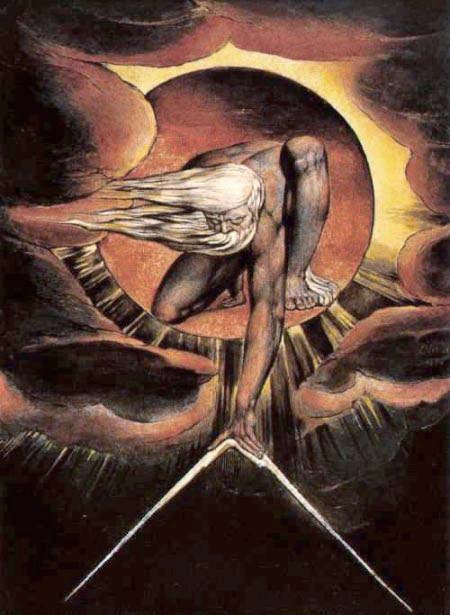
This is a watercolour and relief etching called "The Ancient of Days" by William Blake.
Ancient of Days is a name for God in Aramaic: Atik Yomin.
In this piece, the Ancient of Days relates to the Medieval idea of God being an Architect, creating the world. He is seen to be holding a compass like device and sitting on the sun, without which we would not exist. The sun with the clouds and rays of light surrounding it may be symbolizing the heavens.
Sunday, October 25, 2009
Favourite quote from Othello
Favourite Othello Quote
Lines 31 and 32
Desdemona to Othello;
"I understand a fury in your words,
But not the words."
This is my favourite quote in Shakespeare's Othello because it portrays the power of emotion and how emotion speaks for itself. This is important in the play because this is what Iago uses to ensnare the characters around him; he toys with their emotions. This quote also highlights Desdemona's innocence and reveals Othello's increasing inability to control his emotions after being blindly manipulated by Iago.
Favourite quote in Othello
Saturday, October 24, 2009
Favourite Othello quote.
(Iago to Othello)
"O, beware, my lord, of jealousy!
It is the green-eyed monster which doth mock
The meat it feeds on."
This is my favourite quote in the play as not only does it show Iago's awareness of the emotion that he can use to toy with in Othello, but it also enables us to see his status as we realise that he is the one to unleash this "monster" in the end.
We can see the personification of jealousy as a "green-eyed monster", and I think that this represents the sheer power of this emotion that begins to eat Othello up in Act 3 Scene 3. Jealousy is a key theme in the play, as it is one of the key reasons behind Othello's downfall at the end.
Thursday, October 22, 2009
Favourite quote
I love how shakespeare experiments with this idea of love being a sect or scion.
Such as how he uses the napkin to portray love being passed from hand to hand, or how he uses the strawberry inscriptions on the napkin to further emphasize the symbolism.
I also enjoy the analogy of emotions being similar to florals, herbs, and plants; mentioned just before this quote. How a person would have to nurture undistinguishable seeds, only to find some were weeds, and nettles that are difficult to destroy once they've grown. I think this idea can be manipulated in many different ways, presenting many different oppurtunities.
Saturday, October 17, 2009
Julia's Favourite Quote From Othello
No, I will speak as liberal as the north:
Let heaven and men and devils, let them all,
All, all, cry shame against me, yet I'll speak. "
This is my favourite quote in Shakespeare's Othello because Emilia has finally pushed to expose the truth instead of making conclusions in her own head, like Othello, or fabricating evidence, like Iago. Emilia, the character Shakespeare protrayed throughout the play previously to be so quiet and compliant, is now shown to have snapped, as if the truth is a force that cannot be contained forever.
Thursday, October 15, 2009
favourite quote from Shakespeare's Othello
I am not what I am. (line 65) - Iago
This quote highlights the very nature of Iago; a manipulative and deceptive character. this quotation is important because Iago himself admits this, foreboding the events that are about to unfold.
Monday, October 12, 2009
'A liberal hand!'
Othello describes Desdemona’s hand as ‘moist’, ‘liberal’ and ‘frank’, showing his suspicions of her betrayal and his base feelings about her, as if she is now merely a sexual toy now that she has no virtue in his eyes. There is a strong dramatic irony in his speech because Desdemona is completely innocent and ignorant of the hinted accusations that Othello is making, while Othello believes she is aware and so becomes more incensed by her apparent dishonesty throughout the scene.
Through Othello’s phrase ‘The hearts of old gave hands; but our new heraldry is hands, not hearts’, the audience can see that he has lost his faith in the honour of love, since Desdemona gave her hand in marriage but perhaps not her heart. He is also implying that he can discern her disloyalty through the use of the word ‘heraldry’, as if Desdemona’s hands confess her betrayal because of their ‘moist’ quality.
This speech shows that Othello has begun to speak like Iago because of its continual sexual references, showing the audience his descent from the nobility and honour he began with. The speech also shows that he is overcome with anger and so will use any evidence, even the quality of Desdemona’s hand to accuse her of her disloyalty because he already believes he has been betrayed.
Friday, October 9, 2009
Act III Scene 4; and its significance.
The significance of the handkerchief is also explored in this scene. The handkerchief acts as a symbol of Desdemona’s fidelity. Shakespeare, through Iago had suggested that the handkerchief was not the only thing she was giving away; Othello in this scene highlights how special and magically significant the handkerchief is in itself by explaining the source of its alleged power, that how losing it or giving it away is tantamount to ending their love. This is important as it reminds the audience of the alleged claims that Brabantio made in the opening scenes of the play that Othello had used charms and witchcraft to win Desdemona’s love.
Thursday, October 8, 2009
Act III, Scene IV. Of Hands and Handekerchiefs.
In the scene prior to Act III, Scene IV (Act III, Scene III), Othello condemns both Desdemona and Cassio, vowing that nothing at all will sway his thoughts towards his wife, and ordering Iago to kill Cassio. As we have previously witnessed, Othello’s character and mentality has completely changed, and for the first time in the entire play, in Act III Scene IV the audience sees an argument develop between Othello and Desdemona.
This is the point in the play where other people (i.e. Desdemona and Emilia) notice how Othello has changed his demeanour. Before, Othello’s turmoil was only shown in front of Iago, but here we have Othello, in public, quarrelling with his wife – and more importantly, completely losing his confidence and calm. Due to his constant demands for Desdemona to find the handkerchief, Othello works himself into a state of hysteria – losing his “regal” and “noble” bearing. This scene marks the first direct effect of Iago’s machinations on someone other than Othello (Desdemona).
An important point to note about Othello’s behaviour is his abruptness with his wife, which is not unlike Act III Scene III when Iago speaks to Emilia. Iago just makes demands of Emilia, like Othello’s demands to Desdemona to fetch the handkerchief. And then there is Othello’s references to Desdemona’s “moist” hand which could mean that she is being unfaithful. He implies that Desdemona is liberal in her affection, much like Iago commenting to Emilia that she is a “common thing”, i.e. also liberal with her affections.
This scene is also important because it highlights the foolishness and fickleness of men. Firstly this is done through Shakespeare’s use of the clown character, who makes a comment that men are only capable of doing menial things. Then Emilia highlights their fickle mindedness with her speech where she likens men’s affection for women to a satisfaction of someone’s appetite. On the surface, it is as if Emilia is speaking her true thoughts of Iago’s treatment of her, but on looking deeper one could see this as a reference to Othello’s sudden change of heart. As he now casts Desdemona aside, like a chicken bone after devouring all its meat. Thirdly through Bianca and Cassio’s exchange, where Bianca is resigned to accept her lot as a woman, accepting Cassio’s coarseness in his attitude, and his quick dismissal of her, as if there is no other possible outcome to being a woman.
It is interesting to compare this scene with the scene from Act I where the audience is first introduced to Othello – an Othello who can eloquently diffuse the violence about to erupt in a particular situation. In this scene however, we get the sense that Othello’s anger is just building and building, until finally when it seems as if he is about to explode with rage, he flees the scene instead of standing his ground. This exit of Othello’s is important, because it leaves Desdemona in such a state of shock and confusion that she does not go after him, but instead bids Iago to go to him, giving Iago leave to further manipulate Othello in a vulnerable state.
The final most important point in the scene is the very brief exchange between Cassio and Bianca, where he gives here Desdemona’s handkerchief that he has found. The audience does not know at this point how and why he has Desdemona’s handkerchief (though one can probably guess that Iago had something to do with it). Shakespeare has chosen to end the scene with a cliffhanger. We have already seen that Othello is a different person, and suffering inside, and Iago finally has position of lieutenant, so at this point there is no rational reason why his plans need to continue. We know that nothing good can come of Cassio giving the handkerchief to Bianca, and much like the end of Act III Scene III, the audience is again left feeling extremely tense, because we cannot foresee what Iago intends to do next with his plans.