Link for more information on the inspiration behind Keats' poem:
http://englishhistory.net/keats/poetry/odetoanightingale.html

Monday, December 7, 2009

Sunday, December 6, 2009
Ode to Psyche- "soft conched ear"

In Ode to Psyche by Keats, the poestic voice refers to Psyche's "soft-conched ear" in line 4.
A conch shell looks like this (see above)
Notice the pinkish skin colour of the inside of the conch and how it does have the shape of a human ear.
Just thought it would be nice to post up the picture so everyone can picture the imagery in the poem more clearly :)
Thursday, December 3, 2009
The Sweatshop Child
They click their clocks to clogged hearts
Force clobbered, cracked bones craft
Such senseless acts will reinact
As we will tempt it back
You'll beat for blood branded oaths
To back yourselves in beauty clothes
Must every store and every isle?
Steal life from every child?
Might children croon for little cradle
The corporate cost, such craze a fable
Will tell their tale like timed task
To tempt their tampered moral mask
Force clobbered, cracked bones craft
Such senseless acts will reinact
As we will tempt it back
You'll beat for blood branded oaths
To back yourselves in beauty clothes
Must every store and every isle?
Steal life from every child?
Might children croon for little cradle
The corporate cost, such craze a fable
Will tell their tale like timed task
To tempt their tampered moral mask
Thursday, November 26, 2009
The Blind Man
I asked a blind man, once, if he
Wished for a second chance to see
The world again with clear new eyes
And lose himself in clear blue skies.
“But how?” he asked, “For they are grey
And underneath, nought but decay.
The tender grass, the timid blooms
All crippled by our noxious fumes.
The heavens pierced by gleaming towers.
Their cruel sores bleed corroding showers;
And all the while the ocean grows
As if to binge away her woes.
So with my new unclouded eyes
I’d only see dark clouded skies.
You think you’re privileged to see;
In fact, you are as blind as me.”
Wished for a second chance to see
The world again with clear new eyes
And lose himself in clear blue skies.
“But how?” he asked, “For they are grey
And underneath, nought but decay.
The tender grass, the timid blooms
All crippled by our noxious fumes.
The heavens pierced by gleaming towers.
Their cruel sores bleed corroding showers;
And all the while the ocean grows
As if to binge away her woes.
So with my new unclouded eyes
I’d only see dark clouded skies.
You think you’re privileged to see;
In fact, you are as blind as me.”
Monday, November 23, 2009
Merciless
Sobbing, sobbing robin
Under leaves so old,
In the plain white snow.
'Why are thou sobbing?'
Merry, merry sparrow
I hear them say that
On the distant hill
Her wings are clipped
And her feet are tied
And her eyes are caged.
I know t'was my fault,
For I did not forgive her
It was my fault,
Because there was no Mercy.
(Inspired by Caged Bird by Maya Angelou; a mirror poem to The Blossom by W. Blake in Songs of Innocence)
Under leaves so old,
In the plain white snow.
'Why are thou sobbing?'
Merry, merry sparrow
I hear them say that
On the distant hill
Her wings are clipped
And her feet are tied
And her eyes are caged.
I know t'was my fault,
For I did not forgive her
It was my fault,
Because there was no Mercy.
(Inspired by Caged Bird by Maya Angelou; a mirror poem to The Blossom by W. Blake in Songs of Innocence)
The Window
You gaze intently into the crystal pane
Examining the world beyond the barrier
You see a man, one who goes by no name
And the purest of hearts is what he bears
You watch him - his every thought, his every move
You watch slowly slip into anxiety as
You watch them win, you watch him lose
You watch him fall into the clutches of society
You see a fresh man, face devoid of Soul
You see him march the streets, living to conform
You see his faith tainted, his loss of control
You can’t help but see obliteration take form
You squint as rays of light strike the glass
And you hear a piercing scream, so cold
For the window was not of the world
But a window to your dwindling soul
Of physicality.
The human heart is the core of existence,
It is broken and mended repeatedly in the vicious cycle of life.
The human mouth, mated to lies, seek refuge in ignorance,
Its words, as sharp and painful as a knife.
The human eyes are the windows to the soul,
It only sees what the mind is willing to perceive.
The human ears feed the mind false console,
It detects the mirage, what it wants to believe.
The human mind toys with fears, emotions and resistance,
Its vulnerability makes it our weakest and strongest feature.
The human body completes the existence,
It makes up this compelling creature.
It is broken and mended repeatedly in the vicious cycle of life.
The human mouth, mated to lies, seek refuge in ignorance,
Its words, as sharp and painful as a knife.
The human eyes are the windows to the soul,
It only sees what the mind is willing to perceive.
The human ears feed the mind false console,
It detects the mirage, what it wants to believe.
The human mind toys with fears, emotions and resistance,
Its vulnerability makes it our weakest and strongest feature.
The human body completes the existence,
It makes up this compelling creature.
Humanity
Seasons come in the cold,
Reluctant to turn the clocks back,
A mere hour of change,
Creeping into the cruel web.
Fingers on plastic keys,
And coffee so black one can taste
the bitterness
Sneaking up and into the snouts
of humanity.
Coffee without white sugar.
Seasons come in the sun,
Reluctant to turn the clocks forward,
A mere hour of progress,
Oozing from the web.
Sunday, November 22, 2009
Mass (poetry homework)
One of the themes that Blake deals with in his poems is disillusionment with the Church and authority in general. I had that in mind, and tried to keep it in the quatrain aabb rhyme style.
---------
Mass
What echoes through these hallowed halls
Are desperate, dragging footfalls
Of disillusioned gentlemen,
Who stop to listen now and then.
They doff their caps and bow to Him
Eyes fixed ahead, their smiles so grim
And take their places two-by-two,
Sitting rigid at every pew.
The choir sings and all must rise
Their prayers dispensed to disguise
The Faith and Devotion they lack,
As pious eyes stare down their backs.
They raise their arms to glorify
But in their hearts and souls they lie
These gentlemen are not His men,
Who pretend to listen now and then.
Saturday, November 21, 2009
William Blake - The Human Abstract


 Capitalisation in the poem:
The capitalisation in The Human Abstract draws attention to the 7 qualities described in the poem, Pity, Mercy, Peace, Cruelty, Humility, Mystery and Deceit. Capitalising these qualities gives them an increased importance in the reader's mind while reading the poem, as it transforms the qualities from being abstract to tangible reality.
Effect of the pronoun "we":
The use of the collective pronoun "we" in the poem is used to include the reader and human society in the poem. For example, the use of "we" in stanza 1 in reference to Pity and Mercy, "If we did not make somebody poor," and "if all were as happy as we" suggests that our actions, the actions of the human race necessitate Pity and Mercy.
In The Divine Image, which is the complementary poem to The Human Abstract in Songs of Innocence, Pity and Mercy are presented to the reader as good, divine qualities that all humans possess. However in this poem, Pity and Mercy arise as a direct result of poverty and unhappiness.
By using the pronoun "we" at the very beginning of the poem, Blake ensures that the reader has themselves and society in mind while reading the rest of the poem, creating links between themselves and the qualities mentioned after stanza 1
Effect of the metaphor tied to the idea of Mystery:
Mystery is described as "[spreading] a dismal shade," creating a contrast between light and dark. That is to say, Mystery is casting shadows, therefore it is spreading uncertainty.
"And the caterpillar and fly / Feed on this Mystery," - caterpillars and flies are insects, pests. This could be a reference to society, and that uncertainty and mystery are nourishment for those who resemble pests, or that Mystery is a negative feeling to spread because it is only fit for insects to feed on.
The connotations of the raven

A raven is a large, black, crow (left) which feeds on carrion - the decaying flesh of other animals. As such, a raven often symbolises darkness, death and evil.
The raven in The Human Abstract has made his nest in Deceit's "thickest shade", implying that it is lurking in the shadows, waiting for death to occur. The image created by placing a pitch-black scavenger bird in thick shadows is one of a predator lying in wait for fresh meat.
This relates to the quality of Deceit, which is about making people the victims of a lie, suggesting that the raven is lying in wait to feed off the victims of deceit.
Why the fruit of Deceit is sweet and the effect this has syntactically and on the meaning conveyed:
The metaphor of Deceit as a fruit that is "Ruddy and sweet to eat,"

relates directly to the duplicitousness of Deceit. Lies seem good on their surface because it is intended that we accept the lie, and they seem "sweet" because they should seem to somehow work in our favour in order for us to ingest them completely, much like how we eat fruits which look appealing, and continue to eat them because their taste agrees with us.
Deceit seems positive when presented as a fruit that is ruddy and sweet, however the intent behind its growth is not. "Ruddy" calls to mind an apple, and the general metaphor of this tree growing in the poem suggests that Tree of Knowledge in the Garden of Eden. God told Adam and Eve not to eat the apples from the Tree, however Eve was persuaded, through the deceit of the Serpent to eat the apple, and thus Adam and Eve gained original sin, a taint they then passed down to the human race.
What Humility is and why it "takes root" underneath Cruelty's foot, and what it communicates to the reader:
One interpretation of humility is that it is the lowering of one's own importance. Looking at it this way, we can interpret that Humility taking root at the feet of Cruelty suggests that, as a result of Cruelty, our selves are lowered in status and importance. Or that Cruelty forces people into submission.
Humility can also be viewed positively - we can say that someone has humility if they are modest and humble. Because Humility is the "root" of the tree, perhaps this means that humility is within us all, or is the "base" from which we all stared. However, if "watered" with the tears of Cruelty the way plants may be watered in a garden, out of the Humility grows the shade of Mystery and the fruit of Deceit.
The Chimney Sweeper - Songs of Innocence
The Chimney-Sweeper is a poem that highlights the cruel situation of child labour and the escape that God can offer the children who have been locked up by society.
How does Blake evoke a strong sense of pity for the children in the poem?
Blake evokes a strong sense of pity from the reader for the children in several ways. Firstly, he bombards the reader with a list of things that has happened to the speaker within the first few lines of the poem; "When my mother died, I was very young, / And my father sold me" (lines 1-2). The use of diction "and" and "so" is also repeated throughout the poem, and this adds to the sense that horrible events just continue to pile up on the children, "and" meaning "to make things worse" and "so" meaning "as a result of this".
In line 3, the child "could scarcely cry 'weep weep weep weep'". The auditory imagery highlights the vulnerability of the child, and the fact that the child could "scarcely cry" shows that the children did not have the power to speak or alert others of the horrible situation in which the lived, adding to the sense of helplessness.
How does Blake use imagery for impact?
Blake continues to evoke empathy throughout the poem with the use of imagery to describe/highlight three main points;
The last stanza stands out from the rest of the poem because throughout the poem the speaker appears to be in a dreamlike state, while the last stanza brings the speaker as well as the reader back into reality, which is "if all do their duty, they need not fear harm". This last line shows that these innocent children have been manipulated into believing what others tell them and into following authority, which continues to evoke sympathy from readers. The last line also seems to finalise the fact that there is really no escape; all the children have are their hopes and dreams as a temporary escape from the harsh reality.
What ironies does Blake highlight in this poem?
Blake highlights several ironies in this poem. Firstly, the last line of the poem is ironic because their duty is, in fact, very harmful for the children. This reinforces the point that Blake is trying to make concerning the lack of hope. In line 19, "the angel told Tom if he'd be a good boy, / he'd have God for his father and never want joy". This seems like a false promise because these children are pure and they are good, and it is as if the only way they would ever never want joy is if they died. Would these children rather find peace in death or live life as a chimney-sweeper? The third irony highlighted in this poem is in line 23 "though the morning was cold, Tom was happy and warm". This highlights the nature of children and how they try to be happy by searching for the positive in everything. However, we all know that it is futile, especially as this line is coupled with the last line of the poem, adding to the effect and sense of helplessness.
What are the most evocative elements in this poem? Why?
In my opinion, one of the most evocative elements in this poem is the blatant contrast of the imagery of the innocent children and the situation that they are in, as this evokes a strong sense of pity from the readers. Another evocative element in the poem is the subtle accusatory tone, which is found in several parts of the poem; "so your chimneys I sweep" (line 4), "locked up" (line 12) and "if all do their duty" (line 24). This tone pulls readers in and open their eyes to the reality of the situation these children are locked up in.
How does Blake evoke a strong sense of pity for the children in the poem?
Blake evokes a strong sense of pity from the reader for the children in several ways. Firstly, he bombards the reader with a list of things that has happened to the speaker within the first few lines of the poem; "When my mother died, I was very young, / And my father sold me" (lines 1-2). The use of diction "and" and "so" is also repeated throughout the poem, and this adds to the sense that horrible events just continue to pile up on the children, "and" meaning "to make things worse" and "so" meaning "as a result of this".
In line 3, the child "could scarcely cry 'weep weep weep weep'". The auditory imagery highlights the vulnerability of the child, and the fact that the child could "scarcely cry" shows that the children did not have the power to speak or alert others of the horrible situation in which the lived, adding to the sense of helplessness.
How does Blake use imagery for impact?
Blake continues to evoke empathy throughout the poem with the use of imagery to describe/highlight three main points;
- The innocence and fragility of the children, as well as their youth
"curled like a lamb's back" (line 6) - young and innocent
"the soot cannot spoil your white hair" (line 8) "naked and white" (line 17) - angelic/cherub-like presence, highlights purity of the soul - The conditions in which the children live and how society is responsible for this
"locked up in coffins of black" (line 12) - the words "locked up" shows that they have been forced unwillingly by society in their situation. "coffins of black" could symbolise chimneys, and the use of the word "coffins" is related to the fact that many chimney-sweepers died working. This imagery places the blame on society, because if there was no demand for chimney-sweepers, then these children would not be in this situation - The life that these children should be living
"down a green plain leaping, laughing they run, / and wash in a river and shine in the sun" - this pastoral imagery is used to show the freedom that these children deserve and how they belong in nature, not in the industrial world
The last stanza stands out from the rest of the poem because throughout the poem the speaker appears to be in a dreamlike state, while the last stanza brings the speaker as well as the reader back into reality, which is "if all do their duty, they need not fear harm". This last line shows that these innocent children have been manipulated into believing what others tell them and into following authority, which continues to evoke sympathy from readers. The last line also seems to finalise the fact that there is really no escape; all the children have are their hopes and dreams as a temporary escape from the harsh reality.
What ironies does Blake highlight in this poem?
Blake highlights several ironies in this poem. Firstly, the last line of the poem is ironic because their duty is, in fact, very harmful for the children. This reinforces the point that Blake is trying to make concerning the lack of hope. In line 19, "the angel told Tom if he'd be a good boy, / he'd have God for his father and never want joy". This seems like a false promise because these children are pure and they are good, and it is as if the only way they would ever never want joy is if they died. Would these children rather find peace in death or live life as a chimney-sweeper? The third irony highlighted in this poem is in line 23 "though the morning was cold, Tom was happy and warm". This highlights the nature of children and how they try to be happy by searching for the positive in everything. However, we all know that it is futile, especially as this line is coupled with the last line of the poem, adding to the effect and sense of helplessness.
What are the most evocative elements in this poem? Why?
In my opinion, one of the most evocative elements in this poem is the blatant contrast of the imagery of the innocent children and the situation that they are in, as this evokes a strong sense of pity from the readers. Another evocative element in the poem is the subtle accusatory tone, which is found in several parts of the poem; "so your chimneys I sweep" (line 4), "locked up" (line 12) and "if all do their duty" (line 24). This tone pulls readers in and open their eyes to the reality of the situation these children are locked up in.
Thursday, November 19, 2009
Questions on "The Lamb"
Comment on the auditory effects of the poem
The diction Blake uses contributes to the auditorily pleasing effect of the poem. Most of the words in the poem are mono-syllabic, which highlights its simplistic nature which in turn emphasizes the innocence and pureness of the lamb. The endings of each line are usually soft and long and coupled with a pleasing vowel sound reflects upon the lamb's innocence and in addition adds a comforting effect. This for example is illustrated in the lines:
"Gave thee life and bid thee feed / By the stream and o'er the mead"
How does the rhyme scheme add to the reading of the poem?
The rhyme scheme "AABB" gives the poem a sense on continuity; it flows smoothly without any disruptions. which again adds to the pleasant and calming effect. It makes the readers feel soothed and relaxed upon listening to it being read.
What does the imagery suggest about Blake's view of the Lamb?
The visual imagery portrayed in this poem are very pastoral. This highlights the innocence of the lamb as readers get a picture of an idyllic habitat in which it lives in. Blake views the lamb as a creature of innocence but at the same time also vulnerable. This is emphasized through his use of diction such as the word "softest", which is used to describe the lamb's lavish coat of fur. This suggested that the lamb is pampered and provided with the best form of protection for its body. Additionally, the word "tender", which is used to describe its voice depicts an image of a child who has not been exposed to the harsh and real world yet.
What literary devices add to the pleasant effect of the poem?
The use of assonance, the repetition of the 'e' sound is especially emphasized in the second stanza. The sound is akin to the bleating of a lamb, and is also a sound associated with happiness and cheerfulness. Also, the diction used to describe the lamb in the poem makes the lamb appear non-threatening and harmless as there are no negative connotations implied by any of the words in the poem. The use of capitalization in the poem is significant. The capitalization of "Lamb" and "God" suggests that they are both interrelated to each other and are of equal importance. Also, the use of the epithet "Little Lamb" emphasizes the lamb's innocence both physically (how it is young) and mentally (how it is vulnerable)
What is the effect of indentation and the use of rhetorical questions?
The use of indentation is to split the poem into two parts; the first part from lines 1 to 10, and the second from lines 11 to 20. The first part of the poem consists of rhetorical questions while the second part provides answers to the questions that are posted. I think the significance of this is to bring the attention to the readers that there is only one answer for all the questions asked, and it is clearly God. The increased use of punctuation, namely full-stops in the second part of the poem gives a degree of finality to the answer, as though it is not to be questioned further or debated. Rhetorical questions in this poem are used to emphasize the power of God as He is the creator of the lamb and the environment in which the lamb dwells. It is as though the poetic voice is asking the lamb how it came to be and the fact that the lamb is unable to answer highlights how innocent and inexperienced it is.
Identify the tone in the poem
A didactic tone is present in the poem, especially in the second part of the poem. It is as though the poetic voice is educating the Little Lamb about the power of God and His creations. There is also a tranquil and serene tone present which gives off a comforting and soothing effect, as though the readers are being told a story due to the poem's hymn-like nature.
The diction Blake uses contributes to the auditorily pleasing effect of the poem. Most of the words in the poem are mono-syllabic, which highlights its simplistic nature which in turn emphasizes the innocence and pureness of the lamb. The endings of each line are usually soft and long and coupled with a pleasing vowel sound reflects upon the lamb's innocence and in addition adds a comforting effect. This for example is illustrated in the lines:
"Gave thee life and bid thee feed / By the stream and o'er the mead"
How does the rhyme scheme add to the reading of the poem?
The rhyme scheme "AABB" gives the poem a sense on continuity; it flows smoothly without any disruptions. which again adds to the pleasant and calming effect. It makes the readers feel soothed and relaxed upon listening to it being read.
What does the imagery suggest about Blake's view of the Lamb?
The visual imagery portrayed in this poem are very pastoral. This highlights the innocence of the lamb as readers get a picture of an idyllic habitat in which it lives in. Blake views the lamb as a creature of innocence but at the same time also vulnerable. This is emphasized through his use of diction such as the word "softest", which is used to describe the lamb's lavish coat of fur. This suggested that the lamb is pampered and provided with the best form of protection for its body. Additionally, the word "tender", which is used to describe its voice depicts an image of a child who has not been exposed to the harsh and real world yet.
What literary devices add to the pleasant effect of the poem?
The use of assonance, the repetition of the 'e' sound is especially emphasized in the second stanza. The sound is akin to the bleating of a lamb, and is also a sound associated with happiness and cheerfulness. Also, the diction used to describe the lamb in the poem makes the lamb appear non-threatening and harmless as there are no negative connotations implied by any of the words in the poem. The use of capitalization in the poem is significant. The capitalization of "Lamb" and "God" suggests that they are both interrelated to each other and are of equal importance. Also, the use of the epithet "Little Lamb" emphasizes the lamb's innocence both physically (how it is young) and mentally (how it is vulnerable)
What is the effect of indentation and the use of rhetorical questions?
The use of indentation is to split the poem into two parts; the first part from lines 1 to 10, and the second from lines 11 to 20. The first part of the poem consists of rhetorical questions while the second part provides answers to the questions that are posted. I think the significance of this is to bring the attention to the readers that there is only one answer for all the questions asked, and it is clearly God. The increased use of punctuation, namely full-stops in the second part of the poem gives a degree of finality to the answer, as though it is not to be questioned further or debated. Rhetorical questions in this poem are used to emphasize the power of God as He is the creator of the lamb and the environment in which the lamb dwells. It is as though the poetic voice is asking the lamb how it came to be and the fact that the lamb is unable to answer highlights how innocent and inexperienced it is.
Identify the tone in the poem
A didactic tone is present in the poem, especially in the second part of the poem. It is as though the poetic voice is educating the Little Lamb about the power of God and His creations. There is also a tranquil and serene tone present which gives off a comforting and soothing effect, as though the readers are being told a story due to the poem's hymn-like nature.
London in Songs of Experience
Effect of the poetic voice using the personal pronoun
Blake's use of personal pronoun throughout the poem makes it seems, of course, more personal, as if Blake is witnessing. This enables Blake to convey a true and more vivid reflection of the events and setting, encouraging the readers to feel, to get more involved into the poem.
Effect of repetition
The diction 'every' is repeated many times in this poem, especially in the second stanza where it is repeated five times. The use of this repetition highlights the fact that all living creatures in London are suppressed and exploited by those in power, and after all depicts the universality of conflict the society as a whole suffers.
Auditory imageries and its effects
Blake employs a concentrated amount of auditory imageries in this poem, especially in the second stanza, such as "cry of every man" (line 5), "infant's cry" (6), "every voice, in every ban" (7), "chimney-sweeper's cry" (9), "hapless soldier's sigh" (11) and "youthful harlot's curse" (14). The poet's use of dictions with very negative connotations, such as 'cry' and 'voice(s) in ban(s)' signifies the overwhelmed sorrow and also creates a chaotic scene. As everyone, from a chimney-sweeper to soldier to a prostitute, from an infant to a man to a prisoner, makes unpleasant noises, such as cries, curses and sighs, a snapshot of mixed sounds generates a somewhat anarchic setting, this contributes to our understanding of how much people suffers due to the growth of capitalism, the cause behind the huge rift between rich and poor in London at the time.
Imageries and its implications
The poet's use of imageries in this poem is brutal. This is shown through "marks of weakness, marks of woe" - the obvious use of metaphor here highlights misery to an extreme level. Weakness and woe are intangible and thus not visible to human eyes; yet Blake writes "mark in every face I meet" which signifies how much people are suffering, to such a level that eventually it becomes visible and leaves a sign on their faces. Another imagery of "the mind-forged manacles" (line 8) conveys brainpower being chained; this advocates the idea that if one accepts dominant ideologies, one will become a prisoner of his/her own mind.
Oxymoron
Blake's use of oxymoron on line 10, "black'ning church appalls" shows irony as churches are supposed to be calming, not "appalling". This emphasises the fact that everything is affected by the growth of capitalism and also its power, as it could turn a peaceful, religious,
holy place into a horrifying one. His use of this device is repeated on the last line of the poem, "the marriage hearse" (16). A 'hearse' is a vehicle for taking the coffin to a funeral, which symbolises grief and death, whilst a 'marriage' is supposed to be loving and happy. This oxymoron underlines the idea of every happy union will end up with death.
Assonance
Blake's use of assonance in the last stanza, in lines 15 and 16: "blasts the new-born infant's tear, and blights with plague the marriage hearse" puts pauses on the 'buh' and 'puh' sounds, which draws the reader's attention, especially to the last sentences of the poem, in order to stress the harshness and brutality of the actual events.
The Blossom - Songs of Innocence
The effect of repetition
"Merry, merry" (line 1), "Pretty, pretty" (line 7), "sobbing, sobbing" (line 10) in the poem create a very light mood that is associated with hymns as well as making the lyric seem like a nursery rhyme. The "sing-song" mood combined with the subject of the poem, being the blossom evokes happiness and innocence as it helps to keep the mood of the poem light. The repetition of "so green" also adds colour to the poem, which further highlights the happiness and innocence that surrounds it.
The repetition of "under the leaves, so green" and "near my bosom" enables us to see a connection between the sparrow and the robin and we feel as if they are linked.
Assonance
In Stanza 1 the "a" sound is repeated - eg. "sparrow", "a happy", "as arrow", "cradle narrow".
The "a" sound is merry and mirrors the "merry, merry sparrow", highlighting the light mood of the poem and the joyfulness.
In Stanza 2 the "o" sound is repeated - eg. "robin", "so", "blossom", "sobbing, sobbing".
The "o" sound has a glorious connotation, however also adds weight to what is being said. In this stanza it is used to perhaps highlight the "sobbing, sobbing" that is revealing a slightly deeper and heavier emotion, while keeping the tone quite innocent.
Personification
The personification of the "blossom" is seen as it is given emotions and feelings, "a happy blossom". The blossom also seems to have a "bosom", like a woman, which may suggest that it is taking care of the sparrow and the robin as they are "near" her bosom. The blossom always keeps the sparrow and robin close to her heart, and this suggests a close relationship between her and the birds.
Blossom also means to develop into something, and it seems as though the relationship of the blossom and the two birds is blossoming and developing as we can see in the poem.
The Title
The title "The Blossom" is plain, yet the imagery of flowers and beauty that it connotes is one that instantly evokes images of spring time and happiness. To blossom also suggests the development of something, which we later on find is the relationship between the flower and the two birds.
The significance of the blossom hearing the robin sob
It seems as though the blossom and the robin are very close friends, seeing as only close friends would cry in front of each other. This again enables us to see the close friendship between the two. The blossom may be crying about industrialisation and the destruction of nature, a theme that is constantly referred to in poems of the Romantic period.
Lines/Phrases that stand out as conveying the key message in the poem
"A happy blossom" (lines 3 and 9) - this line, which is repeated, sums up and reminds the reader of the joyful and light mood of the poem. It also gives the imagery of not only a beautiful blossom, but a happy one, which gives even more glory to the line. A blossom usually can also be when flowers are produced or are growing, which is like the start of a new life. This further highlights the innocence that we feel throughout the poem.
"Near my bosom" (lines 6 and 12) - this line is also repeated in both stanzas of the poem and it is important as it shows just how intimate the friendship between the two birds and the blossom is.
Wednesday, November 11, 2009
Questions on "The Tyger" by William Blake
5) What is the effect of trochaic metre and use of spondee?
Trochaic metre involves a stressed syllable followed by an unstressed syllable, which creates a natural rise and fall during the reading of the poem, making it sound like a song. Take lines 1+2 as an example, “Tiger, tiger, burning bright / in the forests of the night,” the trochaic metre couple with the aabb rhyme scheme have a melodic effect when reading “The Tyger.”
Blake does not consistently use the trochaic metre within the poem, sometimes breaking it, like in line 19, he breaks the trochaic metre, starting the line with an unstressed syllable, creating an involuntary pause in the poem, accentuating the question that the poetic persona is posing, “Did he who make the lamb make thee?”
Blake’s use of spondee adds a somewhat negative feel to certain lines within the poem, because its interruption of the trochaic metre creates heaviness. In line 16, for example, Blake makes use of the words “deadly” and “terrors” which are both spondees. In this particular stanza, the punctuation used by Blake increases the pace at which the stanza is read creating an air of insistence. Having these two spondees juxtaposed with each other significantly slows the pace, causing the reader to linger over the line, changing the attitude from one of insistent questioning, to one of pensiveness.
6) Analyse the syntax and diction of “What dread hand? and What dread feet?
Line 12 makes effective use of the word “dread.” When used as an adjective today it describes something greatly feared, however archaically it was used as an adjective to describe something regarded with awe.
This double meaning that the word possesses is in keeping with the overall tone of Blake’s poem, where the narrative voice is both in awe of the beast while fearing it. The word highlights the idea that the being who created the Tyger must also be revered and dreaded. If Blake hade chosen to use the word “dreadful” the line would not have this double effect.
Blake could have chosen to place the adjective in the line after the noun (i.e. “What hand of dread? And what feet of dread?”) this would have required the addition of the preposition “of” in order for it to make sense, and thus would have interrupted not only the rhyme, but the rhythm of the stanza. With the adjective before the noun, the noun gains more importance, so the reader focuses on the idea of the hands and the feet of the creator, rather than the “dread” attached to them.
Friday, November 6, 2009
William Blake: Jacob's Ladder
 Blake's painting of Jacob's ladder depicts a staircase of angels walkin up and down while Jacob lies at the bottom, asleep. This is supposed to not only show the story in the Bible, where Jacob dreams of the staircase to heaven, but also is supposed to reflect the inner workings of the soul.
I find this painting so fascinating because of its vivid colours, and the graceful movement in the way the angels and the staircase was painted. It is very interesting that the angels look like they are regular people, albeit very beautiful ones, chatting to one another and carrying pots and baskets, as if they were going to and from the market place. Only a few of them have wings. There is a beauty in the normality of the angels' movement, perhaps because what they are doing is so human. This may have been done to signify how people in normal life are in fact incredibly beautiful because of their simplicity and yet colourful emotions.
Farther up the staircase, couples can be seen embracing, symbolising love. This shows Blake's idea that the only way for a person to get to the highest spiritual status is to go through these powerful emotions.
Thursday, November 5, 2009
Blake's work
 Nebuchanezzar
Nebuchanezzar was considered as the King of Babylon, who was punishd by God because of his arrogance. The painting shows him with some resemblence of man and animal. His claws and rough skin gives him animal like characteristics, even his facial expression, shows a terrified expression, similar to that of a frightened animal.
The painting's portrayal of the transition between animal and man, could be Blakes way of emphasizing on the idea, that without arts and imagination, man would be nothing less of an animal. Since Nebuchanezzar was exiled, he was derived of culture and arts, without it, he gradual became an unregconizable animal.
God Judging Adam

"God Judging Adam"
William Blake, 1795
As the title suggests, this etching shows God passing final Judgement on Adam, the first man.
Both men are shown to be old, with long flowing beards and hair. In fact, the only real distinguishing feature between Adam and God is that God is clothed but Adam is not. Possibly Blake is trying to make a point about how men are made in God's image, and thus emphasise how men have failed to emulate God's ideals or teachings.
Adam's nakedness, coupled with the fact that God is seated and elevated above Adam highlights Adam's low status. God seems to be seated on some sort of chariot, pulled by a fantastical horse, whose mane seems quite flame-like. This idea of flames is echoed in the reds and oranges that seem to make up the circular carriage or throne God is seated on. Heaven is not usually associated with fire or flame - maybe Blake is trying to make God seem more terrifying by surrounding God with brushstrokes and colours that bring flames to mind. The use of colour/texture seems to present an atmosphere of anger - God is angry with Adam.
The Ghost of a Flea - By William Blake

To W. Blake , the rationality and attention to surfaces of the English social portrait encapsulated deadening Newtonian materialism; true vision is inward rather than empirical. So, in his 60s, Blake painted his riposte to the English face-painters: the portrait of the spirit, or ghost, of a flea.
Blake's flea is evil, gothic, stalking through a starry realm between stage curtains - walking the boards. The ghost's spine is a throbbing, gristly column shooting into his scaly head with its bulging eyes and voracious tongue; his massive muscles are red-toned, as if infused with dried blood, and his loping, crushing walk is that of a colossus come to life. This vastness and mad-eyed bestiality contrasts with the visible form of the spirit's physical embodiment, which can be seen on the floor between his veined legs: a little flea.
Blake's explanation of the spirit he saw accords with the painting's extreme drama of scale, the contrast of the huge invisible monster with its tiny incarnation as insect. The blood-drinking household flea, said Blake, is in fact the physical shape taken by the souls of men who are so bloodthirsty that they are providentially confined to the size and form of insects.
The ghost is gorging on a bowl of blood. This is Blake's ultimate critique of the English portrait.
William Blake - Good and Evil Angels
 This interesting piece of artwork by William Blake is entitled 'Good and Evil Angels', an ink and watercolour on paper piece. It depicts a 'good' and 'evil' angel struggling for the possession of a child, the 'evil' angel ascending from the fires of hell and the 'good' angel holding onto a seemingly distressed infant in the horizon.
Blake attempts to demonstrate the perfect balance between heaven and earth, good and evil; two archetypal forces moving against each other and yet in harmony. "What would light be without dark, and when all is dark where is wisdom?"
artwork by william blake.

This watercolour piece entitled 'Jacob's ladder' was derived from the book of Genesis (28,12), where Jacob had a dream in which he saw a ladder extending to the gate of heaven.
This ladder in this painting represents an important symbolic motif. It was often used to convey the interlocking world of God, the soul and man. In some Hermetic texts, the ladder was depicted as a series of chains, each representing a different "sphere" of consciousness. All of these spheres were linked together, and like man, were each connected to "the true essence of God."
William Blake's Art.
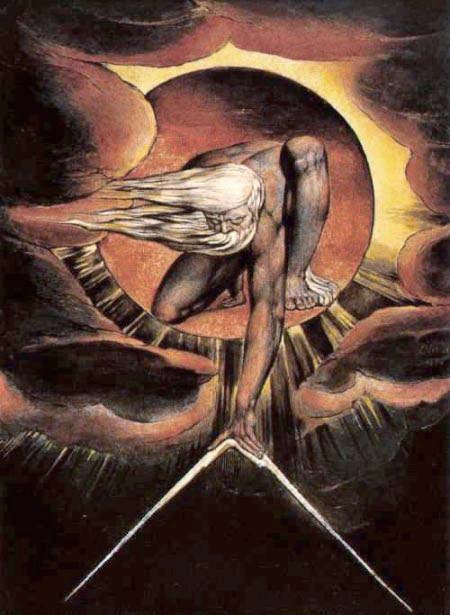
This is a watercolour and relief etching called "The Ancient of Days" by William Blake.
Ancient of Days is a name for God in Aramaic: Atik Yomin.
In this piece, the Ancient of Days relates to the Medieval idea of God being an Architect, creating the world. He is seen to be holding a compass like device and sitting on the sun, without which we would not exist. The sun with the clouds and rays of light surrounding it may be symbolizing the heavens.
Sunday, October 25, 2009
Favourite quote from Othello
Brabantio to Iago
Act I, Sc. I, Line 118
I like this quote because it is short and succint - I love the finality of it, how Brabantio just pronounces Iago for what he is, a villain. There are many words that could be used to describe Iago, like snake, double-crosser, liar, cheat, but the best description him is Brabantio's unwiting one: villain.
But what I really like about the line is that Brabantio has no idea who he is saying it to, because this takes place in the dark street outside his home, where he cannot make out Iago's face. Shakespeare has a character state the truth about Iago at the very beginning of the play, without even realising it, which is what I love most about the quote.
Favourite Othello Quote
Act 4 Scene 2
Lines 31 and 32
Desdemona to Othello;
"I understand a fury in your words,
But not the words."
This is my favourite quote in Shakespeare's Othello because it portrays the power of emotion and how emotion speaks for itself. This is important in the play because this is what Iago uses to ensnare the characters around him; he toys with their emotions. This quote also highlights Desdemona's innocence and reveals Othello's increasing inability to control his emotions after being blindly manipulated by Iago.
Lines 31 and 32
Desdemona to Othello;
"I understand a fury in your words,
But not the words."
This is my favourite quote in Shakespeare's Othello because it portrays the power of emotion and how emotion speaks for itself. This is important in the play because this is what Iago uses to ensnare the characters around him; he toys with their emotions. This quote also highlights Desdemona's innocence and reveals Othello's increasing inability to control his emotions after being blindly manipulated by Iago.
Favourite quote in Othello
Act 1 Scene 1 (Lines 62-6)
"For when my outward action doth demonstrate
The native act and figure of my heart
In complement extern, 'tis not long after
But I will wear my heart upon my sleeve
For daws to peck at."
I like this quote as it exemplifies Iago's cryptic and elliptical manner of speaking, which is also a vital element that Shakespeare has constructed in order to contributing to the extreme dramatic irony of the play.
Saturday, October 24, 2009
Favourite Othello quote.
Act 3 Scene 3.
(Iago to Othello)
"O, beware, my lord, of jealousy!
It is the green-eyed monster which doth mock
The meat it feeds on."
This is my favourite quote in the play as not only does it show Iago's awareness of the emotion that he can use to toy with in Othello, but it also enables us to see his status as we realise that he is the one to unleash this "monster" in the end.
We can see the personification of jealousy as a "green-eyed monster", and I think that this represents the sheer power of this emotion that begins to eat Othello up in Act 3 Scene 3. Jealousy is a key theme in the play, as it is one of the key reasons behind Othello's downfall at the end.
(Iago to Othello)
"O, beware, my lord, of jealousy!
It is the green-eyed monster which doth mock
The meat it feeds on."
This is my favourite quote in the play as not only does it show Iago's awareness of the emotion that he can use to toy with in Othello, but it also enables us to see his status as we realise that he is the one to unleash this "monster" in the end.
We can see the personification of jealousy as a "green-eyed monster", and I think that this represents the sheer power of this emotion that begins to eat Othello up in Act 3 Scene 3. Jealousy is a key theme in the play, as it is one of the key reasons behind Othello's downfall at the end.
Thursday, October 22, 2009
Favourite quote
"whereof I take this, that you call love, to be a sect or scion"
I love how shakespeare experiments with this idea of love being a sect or scion.
Such as how he uses the napkin to portray love being passed from hand to hand, or how he uses the strawberry inscriptions on the napkin to further emphasize the symbolism.
I also enjoy the analogy of emotions being similar to florals, herbs, and plants; mentioned just before this quote. How a person would have to nurture undistinguishable seeds, only to find some were weeds, and nettles that are difficult to destroy once they've grown. I think this idea can be manipulated in many different ways, presenting many different oppurtunities.
I love how shakespeare experiments with this idea of love being a sect or scion.
Such as how he uses the napkin to portray love being passed from hand to hand, or how he uses the strawberry inscriptions on the napkin to further emphasize the symbolism.
I also enjoy the analogy of emotions being similar to florals, herbs, and plants; mentioned just before this quote. How a person would have to nurture undistinguishable seeds, only to find some were weeds, and nettles that are difficult to destroy once they've grown. I think this idea can be manipulated in many different ways, presenting many different oppurtunities.
Saturday, October 17, 2009
Julia's Favourite Quote From Othello
" 'Twill out, 'twill out: I peace!
No, I will speak as liberal as the north:
Let heaven and men and devils, let them all,
All, all, cry shame against me, yet I'll speak. "
This is my favourite quote in Shakespeare's Othello because Emilia has finally pushed to expose the truth instead of making conclusions in her own head, like Othello, or fabricating evidence, like Iago. Emilia, the character Shakespeare protrayed throughout the play previously to be so quiet and compliant, is now shown to have snapped, as if the truth is a force that cannot be contained forever.
No, I will speak as liberal as the north:
Let heaven and men and devils, let them all,
All, all, cry shame against me, yet I'll speak. "
This is my favourite quote in Shakespeare's Othello because Emilia has finally pushed to expose the truth instead of making conclusions in her own head, like Othello, or fabricating evidence, like Iago. Emilia, the character Shakespeare protrayed throughout the play previously to be so quiet and compliant, is now shown to have snapped, as if the truth is a force that cannot be contained forever.
Thursday, October 15, 2009
favourite quote from Shakespeare's Othello
Act I, Sc. I
I am not what I am. (line 65) - Iago
This quote highlights the very nature of Iago; a manipulative and deceptive character. this quotation is important because Iago himself admits this, foreboding the events that are about to unfold.
I am not what I am. (line 65) - Iago
This quote highlights the very nature of Iago; a manipulative and deceptive character. this quotation is important because Iago himself admits this, foreboding the events that are about to unfold.
Monday, October 12, 2009
'A liberal hand!'
In Act 3 Scene 4, Othello’s speech about Desdemona’s hand is extremely important because it shows his shift from the ‘noble’ man he has always been described as, to a more primitive, barbaric character. Through the vulgar imagery that Shakespeare uses, Othello conveys his self-loathing and also insinuates Desdemona’s lack of loyalty. An example of this is when he describes himself as a ‘young and sweating devil’, the vulgar imagery conveying that he believes himself to be consumed by sexual feelings and seems to hint at Desdemona’s sexuality as well. The reference to the devil connotes evil, suggesting that Othello cannot see any goodness within himself anymore.
Othello describes Desdemona’s hand as ‘moist’, ‘liberal’ and ‘frank’, showing his suspicions of her betrayal and his base feelings about her, as if she is now merely a sexual toy now that she has no virtue in his eyes. There is a strong dramatic irony in his speech because Desdemona is completely innocent and ignorant of the hinted accusations that Othello is making, while Othello believes she is aware and so becomes more incensed by her apparent dishonesty throughout the scene.
Through Othello’s phrase ‘The hearts of old gave hands; but our new heraldry is hands, not hearts’, the audience can see that he has lost his faith in the honour of love, since Desdemona gave her hand in marriage but perhaps not her heart. He is also implying that he can discern her disloyalty through the use of the word ‘heraldry’, as if Desdemona’s hands confess her betrayal because of their ‘moist’ quality.
This speech shows that Othello has begun to speak like Iago because of its continual sexual references, showing the audience his descent from the nobility and honour he began with. The speech also shows that he is overcome with anger and so will use any evidence, even the quality of Desdemona’s hand to accuse her of her disloyalty because he already believes he has been betrayed.
Othello describes Desdemona’s hand as ‘moist’, ‘liberal’ and ‘frank’, showing his suspicions of her betrayal and his base feelings about her, as if she is now merely a sexual toy now that she has no virtue in his eyes. There is a strong dramatic irony in his speech because Desdemona is completely innocent and ignorant of the hinted accusations that Othello is making, while Othello believes she is aware and so becomes more incensed by her apparent dishonesty throughout the scene.
Through Othello’s phrase ‘The hearts of old gave hands; but our new heraldry is hands, not hearts’, the audience can see that he has lost his faith in the honour of love, since Desdemona gave her hand in marriage but perhaps not her heart. He is also implying that he can discern her disloyalty through the use of the word ‘heraldry’, as if Desdemona’s hands confess her betrayal because of their ‘moist’ quality.
This speech shows that Othello has begun to speak like Iago because of its continual sexual references, showing the audience his descent from the nobility and honour he began with. The speech also shows that he is overcome with anger and so will use any evidence, even the quality of Desdemona’s hand to accuse her of her disloyalty because he already believes he has been betrayed.
Friday, October 9, 2009
Act III Scene 4; and its significance.
Everything happening in Act III scene 4 serves the purpose of making Iago’s plan better and more believable. In Act III scene 3, he vouched to tear her all to pieces however is stopped by Iago. Iago states that there was not enough proof that Desdemona was being unfaithful then proceeds to inquire about the strawberry-spotted handkerchief in which he claimed that he saw Cassio using. This enraged Othello and he proceeds to demand it from Desdemona. Being unable to produce the missing handkerchief as it was in Iago’s possession, Shakespeare depicts Desdemona’s doom as the lost of the handkerchief acts as a confirmation to all Othello’s suspicions which consequently lead to Act IV, scene 1 which is when Othello determines the way in which Desdemona is to die. In this scene, the plot against Desdemona unfolds. Shakespeare denotes the similarity between the character of Desdemona and Othello. Because they are both strong headed, they don’t give in to each other easily. Determined to get what they want off each other (Othello demands Desdemona to produce the handkerchief he gave her and Desdemona wants Othello to reinstate Cassio), their argument led to no clear conclusion; the more they pushed each other, the more adamant they both became, which further infuriates Othello. The fact that Desdemona could not produce the handkerchief that Othello has asked for confirms her infidelity. However, because she does not know of Othello’s suspicion, she decides that Othello is just trying to get her sidetracked from her mission.
The significance of the handkerchief is also explored in this scene. The handkerchief acts as a symbol of Desdemona’s fidelity. Shakespeare, through Iago had suggested that the handkerchief was not the only thing she was giving away; Othello in this scene highlights how special and magically significant the handkerchief is in itself by explaining the source of its alleged power, that how losing it or giving it away is tantamount to ending their love. This is important as it reminds the audience of the alleged claims that Brabantio made in the opening scenes of the play that Othello had used charms and witchcraft to win Desdemona’s love.
The significance of the handkerchief is also explored in this scene. The handkerchief acts as a symbol of Desdemona’s fidelity. Shakespeare, through Iago had suggested that the handkerchief was not the only thing she was giving away; Othello in this scene highlights how special and magically significant the handkerchief is in itself by explaining the source of its alleged power, that how losing it or giving it away is tantamount to ending their love. This is important as it reminds the audience of the alleged claims that Brabantio made in the opening scenes of the play that Othello had used charms and witchcraft to win Desdemona’s love.
Thursday, October 8, 2009
Act III, Scene IV. Of Hands and Handekerchiefs.
In the scene prior to Act III, Scene IV (Act III, Scene III), Othello condemns both Desdemona and Cassio, vowing that nothing at all will sway his thoughts towards his wife, and ordering Iago to kill Cassio. As we have previously witnessed, Othello’s character and mentality has completely changed, and for the first time in the entire play, in Act III Scene IV the audience sees an argument develop between Othello and Desdemona.
This is the point in the play where other people (i.e. Desdemona and Emilia) notice how Othello has changed his demeanour. Before, Othello’s turmoil was only shown in front of Iago, but here we have Othello, in public, quarrelling with his wife – and more importantly, completely losing his confidence and calm. Due to his constant demands for Desdemona to find the handkerchief, Othello works himself into a state of hysteria – losing his “regal” and “noble” bearing. This scene marks the first direct effect of Iago’s machinations on someone other than Othello (Desdemona).
An important point to note about Othello’s behaviour is his abruptness with his wife, which is not unlike Act III Scene III when Iago speaks to Emilia. Iago just makes demands of Emilia, like Othello’s demands to Desdemona to fetch the handkerchief. And then there is Othello’s references to Desdemona’s “moist” hand which could mean that she is being unfaithful. He implies that Desdemona is liberal in her affection, much like Iago commenting to Emilia that she is a “common thing”, i.e. also liberal with her affections.
This scene is also important because it highlights the foolishness and fickleness of men. Firstly this is done through Shakespeare’s use of the clown character, who makes a comment that men are only capable of doing menial things. Then Emilia highlights their fickle mindedness with her speech where she likens men’s affection for women to a satisfaction of someone’s appetite. On the surface, it is as if Emilia is speaking her true thoughts of Iago’s treatment of her, but on looking deeper one could see this as a reference to Othello’s sudden change of heart. As he now casts Desdemona aside, like a chicken bone after devouring all its meat. Thirdly through Bianca and Cassio’s exchange, where Bianca is resigned to accept her lot as a woman, accepting Cassio’s coarseness in his attitude, and his quick dismissal of her, as if there is no other possible outcome to being a woman.
It is interesting to compare this scene with the scene from Act I where the audience is first introduced to Othello – an Othello who can eloquently diffuse the violence about to erupt in a particular situation. In this scene however, we get the sense that Othello’s anger is just building and building, until finally when it seems as if he is about to explode with rage, he flees the scene instead of standing his ground. This exit of Othello’s is important, because it leaves Desdemona in such a state of shock and confusion that she does not go after him, but instead bids Iago to go to him, giving Iago leave to further manipulate Othello in a vulnerable state.
The final most important point in the scene is the very brief exchange between Cassio and Bianca, where he gives here Desdemona’s handkerchief that he has found. The audience does not know at this point how and why he has Desdemona’s handkerchief (though one can probably guess that Iago had something to do with it). Shakespeare has chosen to end the scene with a cliffhanger. We have already seen that Othello is a different person, and suffering inside, and Iago finally has position of lieutenant, so at this point there is no rational reason why his plans need to continue. We know that nothing good can come of Cassio giving the handkerchief to Bianca, and much like the end of Act III Scene III, the audience is again left feeling extremely tense, because we cannot foresee what Iago intends to do next with his plans.
Shakespeare's Grand Handkerchief
In Act 3 Scene 4, Shakespeare attempts to explain the context of the play through the symbolic use of a spotted handkerchief designed with red strawberries. This first suggestion is seen through Othello’s from line 53 – 65, where he states that the handkerchief is symbolic of their love and it is the true magic that ‘subdues’ Othello. The fact that Desdemona has lost such an item, could be implying that the love and connection between the two, is also lost.
Shakespeare has also choosen very carefully to include strawberries on the designs of the handkerchief. In Greek times, strawberries where seen as a symbol for purity and love, due to its vibrant colors and refined taste, Shakespeare’s use of this idea portray Othello’s corrupted belief, of how the handkerchief represent not only Desdemona’s purity but also the love for her. Hence the lost of this simply item,did not imply a lost of an insignificant item but the lost of Desdemona’s innocence and love.
Another interpretation of Shakespeare’s handkerchief, is of Iago’s shallow crude ideas of love. His reference and imagery of love shown in Act 1 Scene 3 line 315 – 329. He refers to love as a scion or graft, a plant that can be grow from the stolen stems of another. This is exactly how strawberries are grown.
Shakespeare further plays with this idea when Emilia steals Desdemona’s handkerchief ,hence stealing her love, in order to satisfy her longing for love, planting that graft in Iago. This imagery of Emilia cutting a scion from Desdemona’s heart and giving it to Iago, elevates Emilia’s simple crime of stealing a mere handkerchief.
The last imagery that Shakespeare choose to use with the handkerchief is the reality of the handkerchief itself. The purpose of the item is to relieve simple irritations and annoyances. It is almost insignificant. Evenso, when such an item is not present to relieve small annoyances, these insignificant issues, grows.
Shakespeare has also choosen very carefully to include strawberries on the designs of the handkerchief. In Greek times, strawberries where seen as a symbol for purity and love, due to its vibrant colors and refined taste, Shakespeare’s use of this idea portray Othello’s corrupted belief, of how the handkerchief represent not only Desdemona’s purity but also the love for her. Hence the lost of this simply item,did not imply a lost of an insignificant item but the lost of Desdemona’s innocence and love.
Another interpretation of Shakespeare’s handkerchief, is of Iago’s shallow crude ideas of love. His reference and imagery of love shown in Act 1 Scene 3 line 315 – 329. He refers to love as a scion or graft, a plant that can be grow from the stolen stems of another. This is exactly how strawberries are grown.
Shakespeare further plays with this idea when Emilia steals Desdemona’s handkerchief ,hence stealing her love, in order to satisfy her longing for love, planting that graft in Iago. This imagery of Emilia cutting a scion from Desdemona’s heart and giving it to Iago, elevates Emilia’s simple crime of stealing a mere handkerchief.
The last imagery that Shakespeare choose to use with the handkerchief is the reality of the handkerchief itself. The purpose of the item is to relieve simple irritations and annoyances. It is almost insignificant. Evenso, when such an item is not present to relieve small annoyances, these insignificant issues, grows.
Act 3 Scene 4 - Desdemona's handkerchief.
In this scene, Shakespeare highlights the significance of Desdemona's lost handkerchief to the audience, as we can clearly see that this is what the whole play hinges on. The handkerchief was given to Othello's mother by an Egyptian, and lines 52-63 in the scene enable us to see the charm around it. The handkerchief seemed to enable Othello's mother to "subdue [his] father entirely to her love", revealing the spell and power that it had. The fact that it was given to his mother by an Egyptian highlights the exotic background that Othello comes from as well as subtly reminding the audience of Iago's accusation that Othello had charmed Desdemona.
The hankerchief, being white, also represented Desdemona's purity and chastity. Thus losing it would mean that she has lost her purity in Othello's eyes and if she has given it to someone else then this would mean that she has given herself away.
Othello states clearly that the hankerchief was of great importance to him, and implies that their whole relationship hinges upon whether it has been "lost" or not. He retells the story of how "if [his mother] lost it or made a gift of it, [his] father's eye should hold her loathed and his spirits should hunt after new fancies." (line 54). This also foreshadows the loathing that he will feel towards Desdemona, seeing as the audience clearly knows that she no longer has the hankerchief.
Othello is seen to have convinced himself that Desdemona has lost her virtue and honesty with the handkerchief, and this scene reveals the beginning of the events that lead to him killing her in their wedding bed.
The hankerchief, being white, also represented Desdemona's purity and chastity. Thus losing it would mean that she has lost her purity in Othello's eyes and if she has given it to someone else then this would mean that she has given herself away.
Othello states clearly that the hankerchief was of great importance to him, and implies that their whole relationship hinges upon whether it has been "lost" or not. He retells the story of how "if [his mother] lost it or made a gift of it, [his] father's eye should hold her loathed and his spirits should hunt after new fancies." (line 54). This also foreshadows the loathing that he will feel towards Desdemona, seeing as the audience clearly knows that she no longer has the hankerchief.
Othello is seen to have convinced himself that Desdemona has lost her virtue and honesty with the handkerchief, and this scene reveals the beginning of the events that lead to him killing her in their wedding bed.
Act 3 Scene 4
The significance of Act 3 Scene 4 in the context of the whole play Othello
Act 3 Scene 4 occurs after Act 3 Scene 3, the longest and most significant scene in the play where Othello is shown to fall directly into Iago’s cunning trap and is so quickly influenced that he begins to doubt the loyal Cassio and his beloved Desdemona.
In Act 3 Scene 4, Othello approaches Desdemona, seeking evidence, and is pulled into a heated argument where he becomes even more angered due to Desdemona’s persistence for Cassio’s sake. This is significant as it reveals their deteriorating marital relationship as a result of Iago’s manipulation. Othello does not directly ask her about Cassio and misconstrues her words, showing that his character is quick to jump to conclusions, for example when Desdemona cries ‘I’faith, you are to blame.’ (line 93), Othello swears and exits, perhaps indicating that he thinks she is saying that he is to blame for her being with Cassio. Furthermore, he also assumes that she is with Cassio because she continues to talk about him. This deterioration carves the path leading to the destruction of both Desdemona and Othello later on in the play.
Another significant element of this scene is the symbolism of the handkerchief that Desdemona has supposedly ‘lost’. The handkerchief could represent three different things, firstly Othello’s exotic heritage, secondly the love shared between Othello and Desdemona and finally Desdemona’s chastity in Othello’s eyes. By ‘losing’ the handkerchief, the love has diminished between them and Desdemona is no longer pure in Othello’s eyes. However, the audience knows that it has not been lost, but taken away. The audience realises that everything is slowly and flawlessly falling into place, and Shakespeare confirms this when Iago is brought in and he says ‘Is my lord angry?’ (line 126), indicating that this is exactly what Iago wanted to happen.
The relationship between Emilia and Iago is also revealed. Emilia tells Desdemona that she does not know where the handkerchief was, when in fact she gave it to her husband. This shows a certain degree of loyalty to her husband. Additionally, it appears that she may know more than we think, when in line 149 she says to Desdemona, ‘Pray heaven it be state matters, as you think, and no conception nor no jealous toy concerning you.’
Act 3 Scene 4 reveals to the audience the loss of control in the relationship between Desdemona and Othello, as well as how this aids Iago with his ultimate plan. It is as if the characters are now digging their own graves by pulling themselves closer and closer into Iago’s trap.
The Significance of Act 3, Scene 4 In The Context Of The Whole Play
Act 3 Scene 4 is significant in the context of the whole play because it contains the turning point of Desdemona and Othello's relationship and also highlights Desdemona's tragic flaw of being too naive.
From the moment it is introduced into the plot, the handkerchief given to Desdemona by Othello becomes the play's most important symbol. Act 3, Scene 4 assumes the bizarre shape of a perverted trial. From the moment Othello enters, he plays the role of a prosecutor, demanding that Desdemona produce the handkerchief and accusing her of being a whore. Shakespeare's integration of the significance of the handkerchief only in this scene helps to contribute to the dramatic ironies in the play, as Othello did not tell Desdemona the meaning of the handkerchief when he gave it to her in the first place, but only in such a circumstance that he believes she has lost it. Instead of defending herself against her husband's accusations, Desdemona's response by advocating Cassio’s case. The result is a shouting match, wherein husband and wife completely fail to communicate, Othello repeatedly screaming “The handkerchief!” while Desdemona enumerates Cassio’s noble qualities, all of which Othello takes as testimony against her. Shakespeare's chosen diction "zounds" as Othello's final word before his exit highlights Iago's absolute influence upon Othello, as Iago is the only character in the play who uses this strong swearing word. In addition, the fact that he swears directly to his wife and then exits conveys the poor state of their relationship.
Throughout the play, Desdemona is presented by Shakespeare as a naive character who has a pure heart, Act 3 Scene 4 exemplifies this characteristic of hers as being a major tragic flaw. In this scene, she tells the clown to deliver a message to Cassio without hesitating if the content of message would be twisted. Then, when Othello accuses her of infidelity, she does not pick up the clues in his lines and indeed, goes on to plead for Cassio. Later on in the scene, when she talks to Iago - she eventually persists him to find out what "hath puddled his clear spirit" as she believes it is concerning state affairs, not aware of the fact that Iago could further inject poison in Othello's ears of her unfaithfulness. In Shakespeare's construction of Desdemona's statement towards Iago, "men's nature wrangle with inferior things", he has emphasized the dramatic irony as we, the audience, know that Othello is wrestling an inferior thing, his own emotions; yet, Desdemona only believes Othello's "great ones" are to do with the states and does not realise that his emotion for her is an "inferior thing".
By the end of this scene, the plot unfolds without any further assistance from Iago, although he is still involved in manipulating it in some way. He has thus far been so careful to inform the audience of his every plan that it seems like he must have anticipated every turn in the road. As with the characters onstage, Iago’s power with the audience lies in his ability to make them believe he knows more than he does.
Thursday, September 24, 2009
Cassio and Iago.
In Othello, Shakespeare crafts Cassio and Iago to be two contrasting characters, and this is evident from the way that they speak to and about women in the play. Iago does not treat his own wife nicely as seen from Act 2 Scene 1 thus Shakespeare may have wanted to show us that Iago had no respect for any woman, not even his wife.
Iago sees women in a physical way, and makes sexual references towards them when speaking about women and Desdemona in the play. He says "thou shalt enjoy her" (on line 310 page 26) to Roderigo, referring to him merely using her to please him and then that is all she is worth. He refers to "housewives in your bed" and how he would "drown [himself] for the love of a guniea-hen" which shows that he seems to be thinking in primitive and rude ways about women.
Iago also refers to his scheme with references to the "womb", "If thou canst cuckold him, thou dost thyself a pleasure, me a sport. There are many events in the womb of time which will be delivered." (line 360 page 27). Not only does he refer to "wombs" but also cuckolding, disrespecting the women's choice as if they want to be cuckolded or not.
Cassio on the other hand refers to women, and Desdemona in particular (to Iago's delight), as "The riches of the ship" (line 82 page 33). She is likened to treasure and as soon as she enters he says "Hail to thee, lady!", clearly elevating her status even more. The first thing we hear Cassio say about Desdemona is that Othello is lucky to have her. He admires the two of them, and clearly sees Desdemona as something "divine" rather than a mere object belonging to Othello who he admires.
The way in which Iago and Cassio refer to women enables the audience to see their upbringing at the time and Shakespeare enables us to also understand what it was like for women at the time. It seemed as though the men were a lot more dominant, and although people of education and higher status like Cassio elevated their status, Iago shows us that women were under the rule of men and less trusted.
An effect that this has on the audience, especially the female audience at the time, is that it may make them dislike Iago even more to highlight his bad personality. It may have shocked some women to hear him refer to them in that way, thus enabling them to like Cassio, who is a clear gentelman, a lot more than him. Shakespeare may have done this to highlight the tragedy of the play, seeing as it is the character who is evil and not liked that triumphs over and poisons all the others.
Iago sees women in a physical way, and makes sexual references towards them when speaking about women and Desdemona in the play. He says "thou shalt enjoy her" (on line 310 page 26) to Roderigo, referring to him merely using her to please him and then that is all she is worth. He refers to "housewives in your bed" and how he would "drown [himself] for the love of a guniea-hen" which shows that he seems to be thinking in primitive and rude ways about women.
Iago also refers to his scheme with references to the "womb", "If thou canst cuckold him, thou dost thyself a pleasure, me a sport. There are many events in the womb of time which will be delivered." (line 360 page 27). Not only does he refer to "wombs" but also cuckolding, disrespecting the women's choice as if they want to be cuckolded or not.
Cassio on the other hand refers to women, and Desdemona in particular (to Iago's delight), as "The riches of the ship" (line 82 page 33). She is likened to treasure and as soon as she enters he says "Hail to thee, lady!", clearly elevating her status even more. The first thing we hear Cassio say about Desdemona is that Othello is lucky to have her. He admires the two of them, and clearly sees Desdemona as something "divine" rather than a mere object belonging to Othello who he admires.
The way in which Iago and Cassio refer to women enables the audience to see their upbringing at the time and Shakespeare enables us to also understand what it was like for women at the time. It seemed as though the men were a lot more dominant, and although people of education and higher status like Cassio elevated their status, Iago shows us that women were under the rule of men and less trusted.
An effect that this has on the audience, especially the female audience at the time, is that it may make them dislike Iago even more to highlight his bad personality. It may have shocked some women to hear him refer to them in that way, thus enabling them to like Cassio, who is a clear gentelman, a lot more than him. Shakespeare may have done this to highlight the tragedy of the play, seeing as it is the character who is evil and not liked that triumphs over and poisons all the others.
Iago and Cassio
Shakespeare develops the character of Cassio in this scene by using extravagant language, showing him to be a gallant gentleman via the way he treats women with great respect even if they are on a same or lower class. On the other hand, Iago is crafted as a man who criticizes his wife incessantly (100-1 when she lets Cassio kisses her) and makes ugly comments about women in general. Shakespeare explicitly describes Iago’s view of women through lines 108-11, in which he believes that women are play-minded creatures who appear to be all nice and quite when out in public, are just silent images, or just “pictures out of doors” but when all they do at home is whining and talking like “bells” and “wild-cats”. By having Cassio serves as a foil to Iago in terms of relationship between men and women, I think Shakespeare has built a background of the society in which the play is set in, enabling the audience to gain a better knowledge of the characteristics of the expected role of women and men – how men are able to treat women, it is their choice and that women, at the time, are considered to have high status and are respected by others. More importantly, this contrasting portrayal of men-women relationship helps to raise dramatic tension as we gain an understanding of Desdemona being an independent girl who could directly speak to men – thus maybe she will have the power to stop Othello’s blindness in being tricked into the Iago’s scheme.
Iago’s and Cassio’s contrasting view toward women
Posted by Brian
Cassio regards women as figures of perfection1. When Desdemonda enters the ship, he acts as a humble man introducing a great goddess, shown through his use of language. By continuously mentioning the ideas of “hailing” 2 and “heaven” 2 he elevates her to divine beauty. He compares her to a flourish white swam3, which gives an imagery of purity and splendor. One of the most defining characteristics that Shakespeare gives Cassio is his incredible humbleness towards women. And eventhough he is second in command, he uses proper courtesy of asking a for a lady’s hand from Iago 4 . Shakespeare’s decision to include Cassio’s humble courtesy towards the women, in contrast with Iago’s, could have been done to show how it is one of Cassio’s weakness and how Iago uses this to his advantage.
On the other hand, Iago attitude toward’s Desdemona and Emilia shows that he has no respect or value for women. Iago’s character is naturally dishonest, he creates a mask which he hides behind when he talks to Othello. Yet in this scene, you can see Iago’s clearly criticizing Desdemona and Emilia without hesitation, this shows how little little respect he has towards women. Iago goes as far as mentioning that women are of no use other than in bed5.
Unlike Cassio, rather than praising his own wife, he chooses to criticize her. He depicts her as “bothersome” 9, and “noisy” through the use of imagery, such as “Bells in your parlor” 6 and “wild-cats in your kitchen”6.The comparison he used on his wife, clearly shows that he no concern or care for her. Shakespeare might have added this aspect to show that Iago’s character has been foul and vile long before Othello’s decision to not promote him. The fact that Iago cannot be courteous to his wife in front of others shows how stubborn he truly is.
His descriptions of dark brunettes and fair ladies, further emphasizes his inconsideration of female emotions and his ignorant ideas that women are objects for men, with only the use of child bearing8 and for interactions7.
The main function that this scene creates, is to emphasize Iago’s inconsideration of people, to introduce how sensitive and courteous Cassio’s character is, As such that it could potentially be manipulated by the stubborn Iago. This contrast not only creates tension between these characters but also potentially heighten’s the audience’s hate for Iago now that they have learned he views women as a nuissance.
1: “That paragons description and wild fame”
2: “Ye men of Cyprus, let her have your knees Hail to thee, lady! and the grace of heaven,"
3: “One that excels the quirks of blazoning pens”
4: “Let it not gall your patience, good Iago That I extend my manners; 'tis my breeding That gives me this bold show of courtesy.”
6: “Bells in your parlors, wild-cats in your kitchens”
5: “You rise to play and go to bed to work”
7: “If she be black, and thereto have a wit, She'll find a white that shall her blackness hit.”
8: “She never yet was foolish that was fair; For even her folly help'd her to an heir.”
9: “I find it still, when I have list to sleep …She puts her tongue a little in her heart, And chides with thinking.”
Cassio regards women as figures of perfection1. When Desdemonda enters the ship, he acts as a humble man introducing a great goddess, shown through his use of language. By continuously mentioning the ideas of “hailing” 2 and “heaven” 2 he elevates her to divine beauty. He compares her to a flourish white swam3, which gives an imagery of purity and splendor. One of the most defining characteristics that Shakespeare gives Cassio is his incredible humbleness towards women. And eventhough he is second in command, he uses proper courtesy of asking a for a lady’s hand from Iago 4 . Shakespeare’s decision to include Cassio’s humble courtesy towards the women, in contrast with Iago’s, could have been done to show how it is one of Cassio’s weakness and how Iago uses this to his advantage.
On the other hand, Iago attitude toward’s Desdemona and Emilia shows that he has no respect or value for women. Iago’s character is naturally dishonest, he creates a mask which he hides behind when he talks to Othello. Yet in this scene, you can see Iago’s clearly criticizing Desdemona and Emilia without hesitation, this shows how little little respect he has towards women. Iago goes as far as mentioning that women are of no use other than in bed5.
Unlike Cassio, rather than praising his own wife, he chooses to criticize her. He depicts her as “bothersome” 9, and “noisy” through the use of imagery, such as “Bells in your parlor” 6 and “wild-cats in your kitchen”6.The comparison he used on his wife, clearly shows that he no concern or care for her. Shakespeare might have added this aspect to show that Iago’s character has been foul and vile long before Othello’s decision to not promote him. The fact that Iago cannot be courteous to his wife in front of others shows how stubborn he truly is.
His descriptions of dark brunettes and fair ladies, further emphasizes his inconsideration of female emotions and his ignorant ideas that women are objects for men, with only the use of child bearing8 and for interactions7.
The main function that this scene creates, is to emphasize Iago’s inconsideration of people, to introduce how sensitive and courteous Cassio’s character is, As such that it could potentially be manipulated by the stubborn Iago. This contrast not only creates tension between these characters but also potentially heighten’s the audience’s hate for Iago now that they have learned he views women as a nuissance.
1: “That paragons description and wild fame”
2: “Ye men of Cyprus, let her have your knees Hail to thee, lady! and the grace of heaven,"
3: “One that excels the quirks of blazoning pens”
4: “Let it not gall your patience, good Iago That I extend my manners; 'tis my breeding That gives me this bold show of courtesy.”
6: “Bells in your parlors, wild-cats in your kitchens”
5: “You rise to play and go to bed to work”
7: “If she be black, and thereto have a wit, She'll find a white that shall her blackness hit.”
8: “She never yet was foolish that was fair; For even her folly help'd her to an heir.”
9: “I find it still, when I have list to sleep …She puts her tongue a little in her heart, And chides with thinking.”
Cassio and Iago's Treatment of Women
Cassio speaks to women with great respect, using flowery language and almost exaggerated compliments to describe Desdemona and to greet Emilia. He describes Desdemona as ‘divine’ and calls her the ‘riches of Cyprus’, likening her to an angel and a treasure. This conveys Cassio’s admiration for her, showing that he believes that she is special and of a high status. Shakespeare made Cassio say these lines to give the dramatic effect of making the audience feel slightly worried that Iago’s plan to claim that Desdemona and Cassio have a relationship may work, because they seem so close. Even though the audience can see that Cassio’s behaviour stems merely from his sense of courtesy, they can also see that Othello, having spent less time learning the customs in society at the time, may believe that Cassio’s friendly banter is flirtatious instead. He greets Emilia with a kiss, explaining to Iago that ‘tis [his] breeding that gives [him] this bold show of courtesy’. This shows that audience that he was brought up to treat women with care and respect, so even though he does not know Emilia, he treats her as if she is special to him. As Cassio has a ‘person and a smooth dispose’, he must be a man with knowledge of the rules in society, showing that his behaviour towards women makes him more respectable and well liked.
Iago, on the other hand, is shown through his speech to believe that women are annoying and fickle, and have the duty of providing an heir to the family. He does not speak with the same respect as Cassio, but instead ridicules his wife, even if only lightly, by saying ‘you are pictures out of doors, bells in your parlours, wild-cats in your kitchens...’ This comment shows that he thinks women put on different facades in different places, depending on who is around to see them, making them deceitful. It also implies that though Emilia seems quiet outside, she annoys Iago in the house, being too loud, as is suggested by the metaphors of ‘bells’ and ‘wild-cats’. Iago sees women as child-givers, shown by the phrase ‘she never yet was foolish that was fair, for even her folly help’d her to an heir’. The phrase implies that as long as a woman can bear a child, it does not matter how foolish she is. Shakespeare uses Iago’s behaviour towards women to show the audience that he is a complete opposite to Cassio, who almost puts the women above him, and though it was expected for women to be submissive and stick to their duties, when Iago shows that these are his views, the audience is less likely to agree with them, simply because of his dislikeable character.
Iago, on the other hand, is shown through his speech to believe that women are annoying and fickle, and have the duty of providing an heir to the family. He does not speak with the same respect as Cassio, but instead ridicules his wife, even if only lightly, by saying ‘you are pictures out of doors, bells in your parlours, wild-cats in your kitchens...’ This comment shows that he thinks women put on different facades in different places, depending on who is around to see them, making them deceitful. It also implies that though Emilia seems quiet outside, she annoys Iago in the house, being too loud, as is suggested by the metaphors of ‘bells’ and ‘wild-cats’. Iago sees women as child-givers, shown by the phrase ‘she never yet was foolish that was fair, for even her folly help’d her to an heir’. The phrase implies that as long as a woman can bear a child, it does not matter how foolish she is. Shakespeare uses Iago’s behaviour towards women to show the audience that he is a complete opposite to Cassio, who almost puts the women above him, and though it was expected for women to be submissive and stick to their duties, when Iago shows that these are his views, the audience is less likely to agree with them, simply because of his dislikeable character.
Act II, Scene I
Cassio throughout this scene exerts himself to be the ideal and perfect courteous gentlemen. In this scene, his appreciation for feminine beauty is highlighted as he speaks with much enthusiasm about Desdemona’s beauty (more than what most men would speak of when talking about another man’s wife). His romantic character is developed through his description of Desdemona. In lines 62 to 64, he portrays Desdemona as a woman that “paragons description and wild fame”, “excels the quirks of blazoning pens” and is an “essential vesture of creation”. The use of extravagant courtly diction depicts Desdemona’s beauty to be overwhelming; as if it is beyond the ability of humans and their words to describe her thus suggesting that her beauty is divine. This idea is further reinforced when Cassio boldly claims that jagged rocks and sandbanks “as having sense of beauty do omit/ their moral natures, letting go safely by/ the divine Desdemona” (lines 71 – 73). This implies that Desdemona’s beauty is so overpowering that her ship manage to escape the dangers of the storm, rocks and sands because of it.
Being the gentlemen that Cassio is, upon the arrival of Desdemona on his ship he alerts the men on board the ship that “the riches of the ship is come on shore!” (line 83) and insists that the men of Cyprus greet her by “[letting] her have [their] knees” (line 84). This depicts Desdemona as something precious, like treasure and is the fact that the men are kneeling before her is akin to welcoming a goddess or an angel, which is a slightly excessive gesture as they are in the middle of a storm, where everything is wet and muddy. He also extends his welcome to Emilia, Iago’s wife by giving her a kiss to which he explains that “’tis [his] breeding/ that gives [him] this bold show of courtesy” (lines 98/99). This suggests that he was brought up in a well-mannered environment. This in turn emphasizes how charming Cassio is and at this point, the audience feels a little bit worried as they can see clearly how Cassio would fit perfectly into Iago’s evil scheme. This additionally serves as a foreshadow of the manifestation of Iago’s plan as it unfolds throughout the course of the play.
Iago’s disdain for women can be seen in this scene through the pessimistic way in which he speaks about them. This is apparent when he compares women in the quote to insignificant objects;
Furthermore, Iago also describes his idea of a perfect woman in this scene.
He then pauses significantly before concluding his speech with “to suckle fools and chronicle small beer” (line 157) with the intention of winding Desdemona up. The last sentence of his speech suggests that a woman, even if she is perfect is good for nothing more than nursing babies and to keep household accounts of insignificant items such as beer.
The contrast in how different male characters portray female characters highlights the fact that men are dominant and hold more power in a relationship as they can easily promote or demote a woman’s status in the society, especially if they are of a high position in the army (for example, Cassio). This in turn emphasizes the inferiority of women and their position in the social hierarchy during the Elizabethan era.
Being the gentlemen that Cassio is, upon the arrival of Desdemona on his ship he alerts the men on board the ship that “the riches of the ship is come on shore!” (line 83) and insists that the men of Cyprus greet her by “[letting] her have [their] knees” (line 84). This depicts Desdemona as something precious, like treasure and is the fact that the men are kneeling before her is akin to welcoming a goddess or an angel, which is a slightly excessive gesture as they are in the middle of a storm, where everything is wet and muddy. He also extends his welcome to Emilia, Iago’s wife by giving her a kiss to which he explains that “’tis [his] breeding/ that gives [him] this bold show of courtesy” (lines 98/99). This suggests that he was brought up in a well-mannered environment. This in turn emphasizes how charming Cassio is and at this point, the audience feels a little bit worried as they can see clearly how Cassio would fit perfectly into Iago’s evil scheme. This additionally serves as a foreshadow of the manifestation of Iago’s plan as it unfolds throughout the course of the play.
Iago’s disdain for women can be seen in this scene through the pessimistic way in which he speaks about them. This is apparent when he compares women in the quote to insignificant objects;
“Pictures out of doors” suggests that they only pretend to be well-behaved when they are out in public but reveal their true nature at home. “Bells in you parlours” suggests that they are as noisy and annoying as the sound of bells while “saints in your injuries, devils being offended” implies that they are religious in their dedication for revenge but are devil-like when someone faults them. “Players in your housewifery, and housewives in your beds” indicates that they only pretend to be housewives and that they use sexual favours to get what they want, which is further emphasized when he says that women “rise to play and go to bed to work”. What he meant by saying this is that women only really earn their living in bed. Therefore, through the horrible things that Iago says, it is not at all surprising that Iago thinks of women as low and inferior as he compares them to animals and devils.
“you are pictures out of doors, bells
In your parlours, wild-cats in your kitchen, saints in
Your injuries, devils being offended, players in your
housewifery, and housewives in your beds.” (lines 108 – 111)
Furthermore, Iago also describes his idea of a perfect woman in this scene.
‘She that was ever fair, and never proud,Iago’s response highlights the point that a woman should be fair, but not overly stuck up; who was well-spoken but knows when to hold back (knows what her limit is); who had gold but did not overdress just because she had the money; who had self-control; who could control her desire to seek revenge for slights; who had enough sense to distinguish head from tail; who could think without expressing her every thought and who could avoid being distracted by others’ reactions.
Had tongue at will, and yet was never loud;
Never lack'd gold, and yet went never gay;
Fled from her wish, and yet said "Now I may";
She that being anger'd, her revenge being nigh,
Bade her wrong stay, and her displeasure fly;
She that in wisdom never was so frail
To change the cod's head for the salmon's tail;
She that could think and ne'er disclose her mind,
See suitors following and not look behind;
She was a wight, if ever such wight were – ‘ (lines 145 – 155)
He then pauses significantly before concluding his speech with “to suckle fools and chronicle small beer” (line 157) with the intention of winding Desdemona up. The last sentence of his speech suggests that a woman, even if she is perfect is good for nothing more than nursing babies and to keep household accounts of insignificant items such as beer.
The contrast in how different male characters portray female characters highlights the fact that men are dominant and hold more power in a relationship as they can easily promote or demote a woman’s status in the society, especially if they are of a high position in the army (for example, Cassio). This in turn emphasizes the inferiority of women and their position in the social hierarchy during the Elizabethan era.
Wednesday, September 23, 2009
Iago vs. Cassio
Act 2 Scene 1
In this scene, while waiting for the arrival of Othello in Cyprus, Iago and Cassio speak to and of women in contrasting manners. Cassio clearly shows more respect and consideration for women in society, while Iago, on the other hand, exhibits a lack of respect and appreciation, especially towards the woman he married, Emilia.
When Cassio speaks of Desdemona, Othello's wife, he describes her with the utmost respect without lapsing into insincerity;
Most fortunately: he hath achiev'd a maid
That paragons description and wild fame;
One that excels the quirks of blazoning pens
And in th'essential vesture of creation
Does tire the ingener.
Cassio says that Desdemona is so much more than what people describe her as, and that her beauty transcends imagination. By speaking of her in this way, Cassio instantly elevates her status through his inflated compliments, and this is highlighted when Cassio calls to his men 'You men of Cyprus, let her have your knees'. Cassio respects and admires Desdemona, even though she is just a friend and he is not romantically involved with her, indicating that Cassio is respectful towards women in general. He continues to compliment her throughout the scene, calling her 'the divine Desdemona' and 'the riches of the ship', comparing her to something so very rare and valuable.
Cassio also shows respect for Emilia, Iago's wife, when he greets her politely and chivalrously with a kiss. Cassio says 'tis my breeding that gives me this bold show of courtesy', suggesting that Cassio has been brought up in an environment where he was taught to respect women.
Iago, on the other hand, exhibits a very different and negative attitude towards women, to the point where he criticises and disparages his own wife. After Cassio kisses Emilia, Iago says;
Sir, would she give you so much of her lips
As of her tongue she oft bestows on me
You would have enough.
Come on, come on; you are pictures out of doors, bells
in your parlours, wild-cats in your kitchen, saints in
your injuries, devils being offended, players in your
housewifery, and housewives in your beds.
Iago implies that women talk excessively, definitely more than they should, and of useless matters. He says that women are well behaved in public but in the home they are troublesome. In addition to this, Iago makes the vulgar statement, 'You rise to play and go to bed to work', indicating that he thinks women are good for nothing but sex.
In contrast to Cassio, who elevates the status of women, Iago greatly lowers their status, referring to them as objects and animals - pictures, bells, wild-cats, as if they are selfish creatures, and a burden to their husbands.
These contrasting ways in which women are spoken to and spoken of affects our understanding of male/female relationships in the sense that there are two different types of male/female relationships; empowered and constrained. The way that Cassio speaks to women in society is very respectful and courteous. He gives them a voice, an identity and status. However this is only outside of the home. We do not know how Cassio would treat a mistress or a wife. Iago and Emilia's relationship is constrained. Their relationship is an excellent example of power in gender roles in society, with Iago being the powerful masculine persona in the relationship, and Emilia being the weaker feminine persona. The idea that women are inferior to men is exemplified in their relationship, as Emilia is clearly of a lower status to Iago, and Iago constantly verbally abusing her.
Because of the opposing attitudes towards women, Cassio becomes the perfect scapegoat for Iago's plan. His respect for women, in particular Desdemona, makes him the perfect suspect as Iago intends to lure Othello into thinking Desdemona is having an affair with Desdemona, therefore bringing the both of them down. This could foreshadow a terrible ending later on in the play as the more we learn about Cassio and his charming characteristics, the more we realise that Iago's plan could be executed flawlessly. Iago's cruel manners towards his wife also indicates how heartless he is, emphasising his malicious characteristics.
Subscribe to:
Posts (Atom)